
3. Greenhouse gases absorb infrared radiation, but they re-emit it.
Key concepts: Photons. Greenhouse gas Global Warming Potential (GWP). GHG concentrations and lifetimes. Contribution of atmospheric gases to global warming.
Without delving too much into quantum mechanics, electromagnetic radiation energy is carried in the form of energy particles called photons. The energy of a photon is described by the equation E=hν, where h is the “Planck constant”, and ν stands for the radiation frequency. The higher the frequency (the shorter the wavelength), the higher the energy. Shortwave visible light photons carry too much energy for greenhouse gases (GHGs) to ‘absorb’ them. GHGs let them through. GHGs are said to be “transparent” to visible light
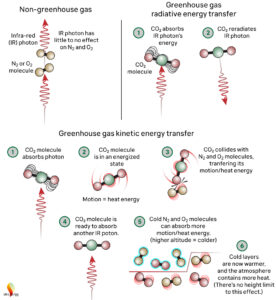
Source: Skeptical Science (sks.to/jg). Used as-is under CC BY-NC-ND 3.0; RAF as Dutch ANBI qualifies for non-commercial educational use.
CO2 however readily ‘absorbs’ a lower-energy infrared (IR) photon. When it does so, the CO2 molecule enters a higher energy state. Physicists call this an “excited state”. CO2 releases this extra energy instantaneously either by re-emitting the photon in a random direction (Kirchhoff’s law on emission = radiation), including back to Earth, or by colliding with other gas molecules, heating the atmosphere. After shedding its extra energy, CO2 falls back to its “ground state”, ready to be excited again. CO2 is therefore unlike a mop, which has to be wrung out regularly in order for it to continue working. CO2 molecules do not get saturated with IR photons. Because a CO2 molecule instantaneously discharges absorbed IR energy, it is immediately ready to absorb another IR photon. CO2 has therefore an almost limitless capacity to heat up the atmosphere. The same holds true for all other GHGs. Doubling CO2 from 270 ppm to 540 ppm will cause several degrees of warming. Doubling again (from 540ppm to 1080 ppm) will result in similar additional warming, and so on. Although there may be a limit to this effect eventually, recent research (He et al. 2023) questions how close we are to this point. But we are a long, long way from reaching that point and in any case, we do not want to go anywhere near it! Even one doubling will have apocalyptical consequences.
Some GHGs can absorb photons over a broader range of IR wavelengths than CO2 due to their more complex molecular structures, which allow for a greater variety of vibrational and rotational modes. This makes them more potent greenhouse gases on a per-molecule basis. However, they may have shorter atmospheric lifetimes. For instance, CH4 (methane) has four carbon-hydrogen bonds that enable it to absorb energy at more wavelengths than CO2, which has only two carbon-oxygen bonds. CH4 is therefore a more potent GHG than CO2. However, CH4 only lasts about 12 years – on average – in the atmosphere, compared to CO2‘s centuries-long lifetime. Despite its shorter duration, CH4 has a more intense warming effect. Its 20-year Global Warming Potential (GWP) is 84-87 times higher compared to CO2‘s 20-year GWP which, by definition, is set at 1. With other words, if a gas, say CH4, has a GWP of 84 on a 20-year timescale, then 1 kg of CH4 generates 84 times the warming effect of 1 kg of CO2 during that period.
Kirchhoff’s Law (ref. Wikipedia, adapted): For an arbitrary body emitting and absorbing thermal radiation in thermodynamic equilibrium, the emissivity function is equal to the absorptivity function. In other words, a substance that is a good absorber of radiation of a certain wavelength, is also good emitter of radiation of the same wavelength.
The overall warming effect of a GHG is the combination of its concentration in the atmosphere and its GWP.
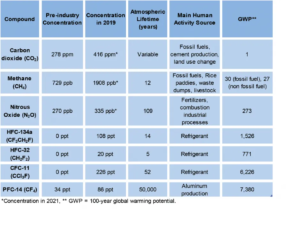
[Ref.: IPCC AR6 Methane GWP Tables ]
Over a 100-year period, CH4’s GWP is lower at 27-30, but still higher than CO2‘s 100-year GWP which again, by definition, is set at 1.
Fortunately, at present, the CH4’s concentration in the atmosphere is 200 times lower, though the scary release of CH4 by thawing permafrost is a tipping point (see Chapter 9. Tipping Points).
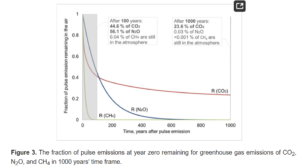
Source: Allen et al., Energies 2020, 13(4), 800. Open access under CC BY 4.0. https://doi.org/10.3390/en13040800
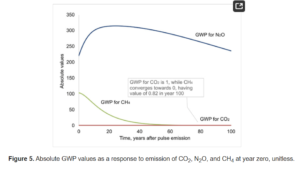
Source: Allen et al., Energies 2020, 13(4), 800. Open access under CC BY 4.0. https://doi.org/10.3390/en13040800
The two above graphs neatly illustrate how to think about GWP, and how devastating, and entirely avoidable, anthropogenic CH4 emissions are on the short term (Energies 2020, 13(4), 800; https://doi.org/10.3390/en13040800).
Some refrigerants have a 100-year GWP over 6,000 (!). Fortunately, the concentration of these refrigerants in the atmosphere is still minute. Therefore, when buying refrigerators, air conditioners, or heat pumps, consumers should choose units with modern, low GWP refrigerants like R-32 (still a GWP of 677!). They should also ensure proper disposal, typically by incineration, of refrigerants in discarded appliances, which contain older, high GWP refrigerants.
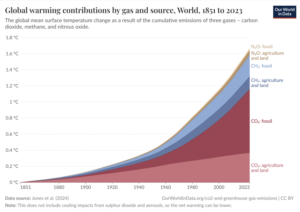
Source: Our World in Data, based on Jones et al. (2024). Licensed under CC BY 4.0. https://ourworldindata.org/CO2 -and-greenhouse-gas-emissions
Overall, the impact of major greenhouse gases on global warming, combining their GWP with atmospheric concentration, continues to rise exponentially (see above image; please note that net warming is lower thanks to the cooling impact of aerosols).
Satellites are now used to detect anthropogenic methane emissions. Negligent oil and gas operators often release vast amounts of CH4 into the atmosphere, which is an act of vandalism given CH4’s 20-year GWP of 87. Methane-detecting satellites now monitor these emissions in order to take the culprits to task. The latest addition, Methanesat, was launched in March 2024 and is the first satellite developed and funded by any environmental nonprofit organization, Environmental Defence Fund: https://www.methanesat.org/. Unfortunately, contact with Methanesat was lost in June 2025, probably due to a mechanical failure. During its short existence though, the satellite gathered invaluable information on anthropogenic methane emissions.
