
2. Greenhouse gases absorb IR radiation emitted by Earth
Key concepts: Solar spectrum. Blackbody radiation. ASR vs OLR. GHGs absorb IR radiation emitted by Earth. Atmospheric Window, Water Vapour Feedback..
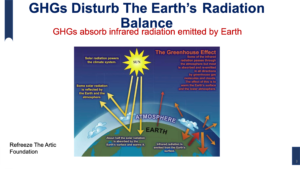
[Ref.: An idealised model of the natural greenhouse effect (IPCC Fourth Assessment Report, 2007)]
During the Holocene, Earth’s climate stabilized due to a balance between incoming solar radiation and outgoing terrestrial radiation, known as the radiation balance. This stability has allowed humanity to thrive.
In the 19th century, scientists discovered that greenhouse gases (GHGs), in particular CO2, are transparent to short-wave solar radiation – they don’t absorb it – but they do absorb the long-wave infrared (IR) radiation emitted by Earth. GHGs re-emit this IR radiation in all directions. While some energy escapes into space, most warms our planet’s atmosphere.
This warming effect is crucial to life on Earth. Without it, Earth’s surface temperature would be around 255 K (-18°C), instead of 287 K (+14°C), turning the planet into a frozen “ice ball”. The calculation of the ice ball temperature is quite straightforward: https://energyeducation.ca/encyclopedia/Earth_Temperature_without_GHGs
With this benign warming in mind, 19th century scientists called these atmospheric gases “greenhouse gases”.
Starting around 1800, the Industrial Revolution saw humans harnessing the heat generated by burning fossil fuels, at first coal, to produce useable energy. This combustion of fossil fuels started releasing massive amounts of anthropogenic CO2 and other GHGs into the atmosphere.
About 50% of anthropogenic CO2 emissions are absorbed by our oceans and land (also check IV. Our oceans act as heat sinks and carbon sinks), while the other 50% of the CO2 emissions accumulate in the atmosphere, trapping ever more terrestrial infrared radiation. This disrupts the radiation balance, preventing terrestrial IR radiation from escaping into space to compensate for incoming solar radiation.
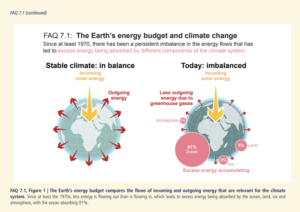
[Ref.: IPCC Sixth Assessment Report Working Group; The Physical Science Basis]
This imbalance is leading to a warming of oceans, which absorb 91% of all excess energy (heat), land, and the atmosphere (also check out Chapter 4. A quantification of energy fluxes). In just 250 years, our gargantuan appetite for fossil fuels has broken the radiation balance that sustained Earth’s climate for 10,000 years.
This explanation of global warming’s root causes is somewhat simplistic, as it doesn’t account for all observed effects. However, it provides a basic understanding of the issue for now.
To understand what goes on in more depth, we must first consider (electromagnetic) radiation.
The Electromagnetic Spectrum.

Source: Adapted from “Electromagnetic-Spectrum.svg” via Wikimedia Commons (CC BY-SA 3.0)
Electromagnetic radiation energy and wavelength are inversely proportional (https://en.wikipedia.org/wiki/Photon_energy). Ultra-shortwave, high-energy gamma rays of 0,0001 nm can pierce through the body while longwave radio waves of 1-100 m are so low in energy that they cause no harm. Visible light (400-700 nm) sits near the middle on a logarithmic wavelength scale.
We must then consider blackbody radiation.
The difference between degree Celsius and degree Kelvin is profound. Degree Celsius starts measuring positive temperature at 0°C, the temperature at which ice melts to become water. By definition, 100°C is the temperature at which water boils (at sea level). Degree Kelvin measures temperature from the moment atomic movement starts, at -273°C. There is no lower temperature than 0 K. Scientists always measure temperature in K. Fortunately, the conversion beteween °C and K is easy. 1°C equals 1K and just add 273 to °C to get Kelvin. Therefore, -14°C equals 259 K and +14°C equals 287 K.
The Sun, a massively ‘high-energy’ hot body with a surface temperature of about 5,778 K (5,505°C), emits massive amounts of high-energy, shortwave radiation, including ultraviolet (UV) radiation, visible light, and near-infrared radiation (NIR). In contrast, Earth is a much smaller ‘low energy’ cold body with a temperature of 287 K (14°C). Earth is almost 20 times colder than the Sun.
Despite its low temperature, Earth still emits low-energy radiation, primarily in the form of longwave infrared (IR) radiation. This phenomenon is known as ‘blackbody’ radiation. The amount of blackbody radiation an object emits is proportional to the fourth power of its temperature (T4), measured in degrees Kelvin (Stefan-Boltzmann Law).
Blackbody radiation can be easily observed in a “white hot” iron rod (or incandescent wood log). Initially, due its high temperature, the “white hot” rod shines almost bright white (a mix of all the visible light wavelengths, including the shortest, high-energy wavelengths from 400 nm to 550 nm) and causes third-degree burns in contact with the skin. As it cools down, it turns yellow (longer, lower-energy wavelengths around 590 nm), then red (even longer, lower-energy wavelengths of 600 nm to 700 nm), but still emits a lot of heat. Finally, after the visible glow fades and the rod or log literally become black bodies, we can still feel heat being released as infrared radiation, which is invisible to the naked eye and has even longer, lower-energy wavelengths beyond 700 nm.
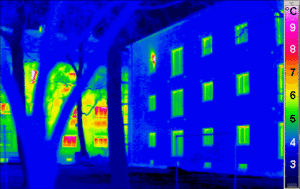
Exterior thermal imaging of “passive house”.

Thermal image of a cat.
[Ref.: Wikipedia; above pictures are licensed under the Creative Commons Attribution-Share Alike 3.0 Unported license.]
Spectral intensity of sunlight (average at top of atmosphere) and thermal radiation emitted by Earth’s surface.

[Ref.: Wikipedia; this image is licensed under the Creative Commons Attribution-Share Alike 4.0 International license.]
We must now reconsider the Earth’s radiation balance, in which incoming shortwave radiation from the Sun must be in balance with IR longwave blackbody IR radiation emitted by Earth. (For the sake of clarity: ‘the Earth’ comprises landmass, oceans and atmosphere). The above curves show the theoretical blackbody radiation intensity of both the Sun (5778 K) and the Earth (287 K). It is noteworthy that these radiation intensities hardly overlap at 3-4 µm.
As discussed in Chapter 4: A quantification of Energy Fluxes, Earth’s albedo—the fraction of solar radiation reflected by bright surfaces—causes ~29% of incoming solar radiation to be reflected back into space unchanged, as shortwave radiation. The remaining ~71% of incoming shortwave radiation is absorbed by the Earth system in various ways and is therefore referred to as Absorbed Solar Radiation (ASR).
Earth as a whole is in radiative equilibrium when at the top of the atmosphere there is a balance between net incoming absorbed shortwave solar radiation (ASR) and outgoing longwave radiation (OLR). Earth maintains this balance by re-emitting the absorbed solar energy (ASR) back into space as infrared (IR) blackbody radiation (OLR). In radiative equilibrium, ASR equals OLR (see above graph).
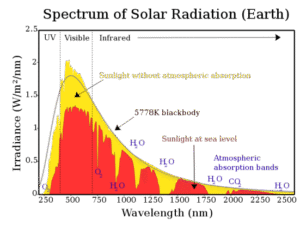
[Ref.: Data from American Society for Testing and Materials (ASTM) G-173-03 reference spectra. Wikimedia, Robert A. Rohde / Global Warming Art.]
Let us first consider the spectrum of ASR in more detail. Atmospheric gases absorb some of the ASR and prevent it from reaching the Earth’s surface (atmospheric absorption bands). Ozone (O3) is essential in this process, as it prevents excessive harmful UV radiation from reaching the surface. Greenhouse gases such as water vapour (H2O) and carbon dioxide (CO2), on the other hand are transparent to incoming visible light (400-700nm) but especially water vapor also absorbs considerable amounts of solar shortwave radiation in the near infrared ( 700-2500 nm). Note that one micrometre (µm) is equivalent to 1,000 nanometres (nm).
[Ref.: Credit: David Bice © Penn State University is licensed under CC BY-NC-SA 4.0; use is for not-for-profit foundation ]
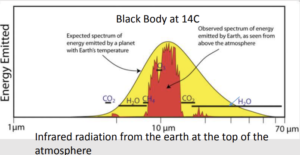
Let us now examine the infrared (IR) radiation spectrum of a blackbody at Earth’s average temperature (14°C, or 287 K). This longwave radiation spans wavelengths from approximately 3 µm to 70 µm (3,000–70,000 nm). Unlike solar blackbody radiation, terrestrial blackbody radiation deviates significantly from the ideal theoretical blackbody energy intensity curve. This deviation occurs because atmospheric greenhouse gases (GHGs) absorb about 90% of the outgoing terrestrial IR radiation and re-emit it in all directions, including back toward Earth’s surface and out into space. As a result, only a narrow “atmospheric window” centered near 10 µm allows terrestrial IR radiation to escape directly into space without significant absorption.

[Refs.: Wikimedia, Robert A. Rohde, Global Warming Art Project, this image is licensed under the Creative Commons Attribution-Share Alike 3.0 Unported icense.]
We can now combine the incoming solar and outgoing terrestrial radiation spectra and compare them with the IR absorption spectra of individual atmospheric GHGs, which all lie in the IR waveband beyond 700 nm (0.7 µm). The total IR absorption spectrum of the atmosphere is the aggregate of the IR absorption spectrums of the individual GHGs. According to quantum mechanics, each GHG absorbs IR radiation at very specific wavelengths. This explains the “ragged” aspect of the ASR and OLR energy spectra (which are confirmed by satellite measurements). Water vapour (H2O) is a potent greenhouse gas, as is carbon dioxide (CO2). But so are nitrous oxide (N2O), and methane (CH4, also known as natural gas). The absorption spectra of these GHGs complement each other to also absorb some shortwave solar IR radiation from reaching Earth.
More importantly, greenhouse gases prevent most of Earth’s OLR, beyond 3 µm, from radiating directly into space, except for an “atmospheric window” extending from abt 8 to abt 15µm. CO2 has a significant IR absorption band at 15 µm and weaker bands within this window, playing a key role in blocking OLR. Thus, CO2 concentrations disproportionately impact the amount of OLR escaping into space. In IV (Energy Fluxes), we will quantify the various energy fluxes involved and show that ASR is very constant. However, due to the rapid increase of the concentration of anthropogenic GHGs in the atmosphere, and that of CO2 in particular, OLR is declining. It is the widening gap between ASR and OLR that leads to global warming.
[Ref.: Pexels ]
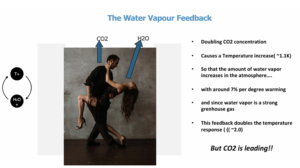
Water vapour (H2O) is indeed a more potent greenhouse gas than CO2, but it is not the primary driver of Earth’s current warming. Increased atmospheric water vapour does not cause global warming; it is a consequence of it. Each degree of global warming increases the atmosphere’s potential to take up water vapour by 7%. Over the oceans, there is enough water to supply this 7% and keep the Relative Humidity (RH) constant, while over land there is less moisture available and RH decreases. Increased water vapour in the atmosphere amplifies the warming caused by other greenhouse gases. The hotter the climate, the more water vapour in the atmosphere, which leads to an even hotter climate. This positive feedback loop is particularly sad news for regions suffering from increased humidity and heat (see The Issue) and yet another example of the plethora of powerful positive feedback loops driving climate change. For a discussion of positive feedback loops, see Chapter 6. Positive Feedback Loops.
For a further discussion of water vapour, look no further than: https://science.nasa.gov/earth/climate-change/steamy-relationships-how-atmospheric-water-vapor-amplifies-earths-greenhouse-effect/

[Ref.: Carbon Brief under Creative Commons BY-NC-ND 4.0; use is for not-for-profit foundation]
Consequently, over the course of recent geological times, fluctuations in CO2’s atmospheric concentration have disproportionally influenced Earth’s climate (see above proxy measurements image).
Conclusions:
since the Industrial Revolution, anthropogenic atmospheric greenhouse gas (GHGs) concentrations have surged, with CO2 levels rising by nearly 50%. GHGs absorb infrared (IR) Outgoing Longwave Radiation (OLR), thereby heating the planet’s surface. CO2 absorbs OLR at wavelengths near the atmospheric window, where the absorption of OLR is typically minimal, thus contributing disproportionally to Earth’s surface warming.
The pace of this change is extraordinarily rapid compared to geological timescales. Anthropogenic GHG emissions have disrupted the Earth’s radiation balance, leading to global warming that now poses a serious threat to humanity’s habitat.
