
Tipping Points
Key concepts: 16 Tipping Points of no return. Cascading effect. Tipping points are the scariest aspect of Climate Change. Defrosting permafrost. Slowing AMOC. Nonlinear Temperature Response. The Climate Repair Deal is a rational insurance policy against systemic collapse.
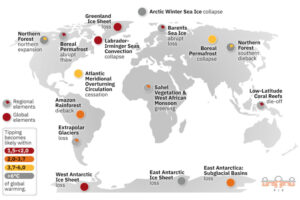
Source: Potsdam Institute for Climate Impact Research (PIK), CC BY licence.
[Ref.: The geographical distribution of global and regional tipping elements, color-coded according to the best estimate for their temperature thresholds, beyond which the element would likely be ‘tipped’. Figure designed at PIK (under cc-by licence), based on Armstrong McKay et al., Science (2022) ]
The Potsdam Institute for Climate Impact Research (PIK) has identified 16 Tipping Points to date. Due to the high uncertainty and constant acceleration of Climate Change, there is a high probability that tipping points within the 1.5 to 3.7°C range will be crossed before the end of the century.
Once a tipping point has been crossed, there is no return. Either the biodiversity is lost forever with calamitous consequences as in the case of coral reefs, or global warming spirals out of control as in the loss of the Greenland ice sheet. And if one tipping point is crossed it most probably triggers the crossing of further tipping points (domino effect, also referred as cascading effect).
Tipping points are the scariest aspect of Climate Change, as Simon Clark explains in this podcast: https://www.youtube.com/watch?v=LxoyaCSWFGs
On the “The Issue” tab of its site, the RAF highlights two tipping points we may already have crossed: the melting of the Greenland Ice Cap and the loss of coral reefs due to rising ocean temperatures and acidification. https://refreezethearcticfoundation.com/global-warming/
(Both tipping points are also explored further in Chapter 6, Arctic Amplification, and Chapter 13, Proposition 5: Coral Bleaching.)
The RAF would like to highlight 2 more apocalyptical tipping points that are knocking at the door.
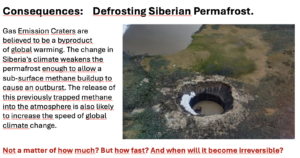
Photo source: Yamal Crater; Buldovicz, Khilimonyuk, Bychkov et al. via Wikipedia (ru.wikipedia.org). Licensed under CC BY 4.0.
One is the defrosting of the arctic permafrost. Arctic permafrost is replete with geological amounts of frozen CO2 and CH4, both powerful GHGs (CH4 has a 100-year GWP of 30, see III. Global Warming Potential). If permafrost thaws, these GHGs will be released into the atmosphere in amounts far exceeding anthropogenic GHG emissions, creating a powerful positive feedback loop that will accelerate the thawing, leading to further emissions, leading to further thawing etc… Global warming will then spiral out of control.
Things don’t look good. In a recent paper, Vikkala et al. (Nature Climate Change, 15(2):188-195) measured that 34% of the arctic boreal zone has now flipped to become a net source of CO2 into the atmosphere after having been a store for CO2 for thousands of years. If CO2 released by boreal fires is added, the percentage increases to 40% (check out Chapter 7, Soot).
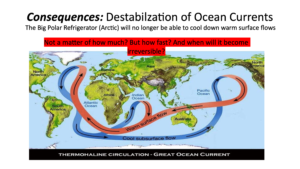
NASA JPL Sea Level Change program. Public domain. https://sealevel.jpl.nasa.gov/ocean-observation/understanding-climate/air-and-water/
The other worrying Tipping Point is the slowdown of the AMOC (Atlantic Meridional Overturning Current). Ocean currents are powered by density gradients: cold water is heavier than warm water, salt water is heavier than freshwater. Warm, salty surface water from the southern Atlantic Ocean sinks to the bottom of the Arctic Ocean when it comes into contact with the icy polar conditions. That powerful pull to the bottom keeps the AMOC flowing. If the sea water “sink” in the Arctic disappears because of Arctic warming and/or because of an increase of freshwater inflow from a melting Greenland ice sheet (see Chapter 6, Arctic Amplification), the vital AMOC could collapse.
Recently, Stephan Rahmstorf at the Potsdam Institute for Climate Impact Research made a 30-minute presentation of his 30 years investigation of the AMOC. In Stephan’s words, the AMOC is Europe’s “central heating”. He concludes that the AMOC is weakening and that a Tipping Point where the AMOC shuts down might be closer than we think. In fact, we might already have crossed it. Without the AMOC, Europe’s climate could become hugely unstable with North Europe cooling by 4°C every… decade: https://www.youtube.com/watch?v=ZHNNW8c_FaA
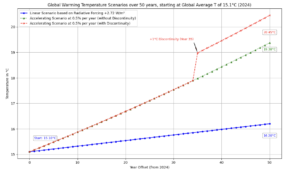
Source: Refreeze the Arctic Foundation (own analysis).
The graph illustrates the systemic risks of climate change, showing how even modest warming can push the Earth toward tipping points with cascading, potentially irreversible effects. All scenarios start from the 2024 global average temperature of 15.1‚ °C—the hottest year on record.
The blue line depicts a steady, linear rise to about 2.2‚ °C above the preindustrial baseline (of ~14.0‚ °C) over 50 years. While gradual, this trajectory still risks triggering multiple tipping points, leaving only a narrow 10–15-year window to implement the three Rs of the Climate Repair Deal.
If warming accelerates – as some studies suggest – temperatures could increase more quickly (green line). Even a modest 0.5% year-on-year rise without solar radiation management (SRM) could push global averages to ~5.4‚ °C above preindustrial levels within 50 years. On such paths, cascading tipping points become far more likely, producing abrupt, non-linear temperature jumps (red line jump arbitrarily set at year 35). These discontinuities—triggered by events such as ice-sheet collapse, major policy failures, or unforeseen positive feedback loops—would make warming effectively unstoppable on human timescales.
The consequences of crossing multiple tipping points are profound: global civilization could collapse, emissions might fall too late to matter, CO2 would linger in the atmosphere for millennia, sea levels would remain high, and ecosystems could be permanently altered. Earth itself would endure, but the climate would not quickly return to a stable, preindustrial state.
This underscores that preventing runaway warming is not optional. Early, coordinated intervention through the Climate Repair Deal is a rational insurance policy against systemic collapse—a way to safeguard the stability of the planet, civilization, and life itself.
