
Vortexes
Key concepts: Meandering Polar vortex. Heat Dome. Big Freeze. Antarctic vortex.
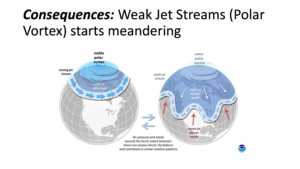
Source: NOAA Chemical Sciences Laboratory. https://csl.noaa.gov/news/2021/301_0128.html
The Arctic vortex is a large area of low pressure and cold air surrounding the Earth’s polar region. It’s typically strongest in winter and helps contain the cold air in the polar region.
As global temperatures rise, the Arctic warms faster than other regions—a phenomenon known as Arctic amplification (Screen & Simmonds, 2010; Chapter 6, Why is the Arctic heating up 3-4 times faster?). Many scientists have hypothesized that this reduces the north–south temperature gradient between the Arctic and midlatitudes, potentially destabilising the jet stream and making it wavier or erratic, which could influence weather patterns in the midlatitudes (Francis & Vavrus, 2012; Cohen et al., 2014; Mewes & Jacobi, 2019). However, substantial uncertainty remains, and not all studies find a strong causal link between Arctic amplification and jet stream behaviour (Nature Communications, 2018; Climate Signals, n.d.).
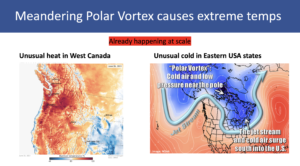
Source: NOAA Climate.gov. Public domain.
A meandering jet stream can cause extreme temperature variations like the 2021 Heat Dome over the West Coast of Canada and the 2021 Big Freeze in Texas. As global warming surges ahead, expect more frequent deep jet stream wobbles causing havoc with the weather in the northern hemisphere.
A stable vortex also exists over Antarctica, maintained by its unique geographical and atmospheric conditions. The Southern Ocean surrounds the continent, keeping the vortex consistent and isolated.
Since the 1980s and 1990s, the Antarctic vortex has been impacted by ozone depletion caused by chlorofluorocarbons (CFCs), used mainly as refrigerants and as propellants in sprays. This depletion cools the stratosphere, strengthening the vortex. Thankfully, international agreements like the Montreal Protocol have helped improve ozone levels and stabilize the Antarctic ozone layer (see Chapter 12, Ozone Depletion).
However, the rapid increase of Antarctic temperature due to global warming is bound to lead to significant and complex changes in the Antarctic vortex that will potentially affect regional and global climate patterns.

Make a donation
invest in the planet's future
RAF’s mission is to prove that MCB can brigthen marine clouds enough to cool the planet and thereby refreeze the Arctic. We have no time to waste. Donate today.