
A better understanding of Global Warming.
Key concepts: Heating from below. Troposphere. Lapse rate. Stratosphere. Ozone layer. Chapman cycle. UV-radiation. Ozone mixing ratio.
Warning: this paragraph is hard to chew, and perhaps even harder to swallow! It relies on a good understanding of the concepts presented in Chapters 2 to 4 (and, with apologies, of some basic chemistry).
In Chapters 2 to 4, Global Warming was depicted in terms of arrows.
It is more accurate to understand that incoming solar radiation heats Earth’s surface, which then warms the atmosphere through latent heat, long-wave IR radiation, and sensible heat. In other words, Earth’s surface heats the atmosphere from below. To maintain the radiation balance, this heat must escape from the outer atmosphere into space. However, heating from below causes the atmosphere to expand subtly (because warm air is less dense, increasing the volume of the atmosphere), making the heat escape from higher altitudes where it is colder. At these lower temperatures, radiating heat back into space is less efficient – since blackbody radiation is proportional to temperature to the fourth power, T4 – reducing the total amount of energy emitted. This imbalance means that Earth must heat up even more from below to restore the radiation balance.
And yes, global warming is influencing the drag of satellites and space debris in the most unexpected ways, leading to the Kessler syndrome, which is discussed in Chapter 12.
By all means, continue to use the slides with arrows to explain global warming (see Chapters 2 and 4). But keep in mind that the reality is rather more complex.
It is useful at this stage to know that our weather is concentrated in the atmosphere’s lowest layer, the turbulent troposphere, which reaches to abt 10-15 km above sea level, depending on latitude (thinner at the poles, thicker at the Equator) and other factors. In the troposphere, temperature decreases with height – at an average rate of abt 6.5°C per km – the so-called lapse rate – reaching an average of abt -60°C at the top (with lower top temperatures at the equator, higher ones at the poles).
In the next layer, the calmer stratosphere, which reaches up to a height of abt 50 km, the temperature curve inverses. Temperature now increases again to about -3°C at the top. This significant temperature increase is mostly due to the presence of ozone – O3 – in the stratosphere.
Tropospheric O3 (ozone) is a potent greenhouse gas that absorbs IR radiation at 9.6 µm right in the middle of the atmospheric window (see Chapter 2, Solar Spectrum). Stratospheric O3 on the other hand plays a different, crucially protective role. When solar, high-energy, shortwave UV-C radiation (~0.25 µm) hits stratospheric O2 (oxygen), its energetic photon (expressed as hν splits the molecule into 2 highly reactive O atoms and is deenergized:
O2 + hν → 2 O
This process – called photolysis – differs fundamentally from how greenhouse gases (GHGs) absorb and release infrared radiation, as GHGs remain intact while O2 molecules are broken apart.
The O atoms combine quickly with O2 to form O3:
O2 + O→ O3
O3 too undergoes photolysis. Solar high-energy, shortwave UV-B radiation (~0.30 µm) hits stratospheric O3, and its slightly less energetic photon (hν) is deenergized by splitting O3 into O2 and an O atom in an excited state:
O3 + hν → O2 + O
The O atom can then recombine with O3 to form two O2 molecules:
O3 + O → 2 O2, or with O2 to form O3 (see above)
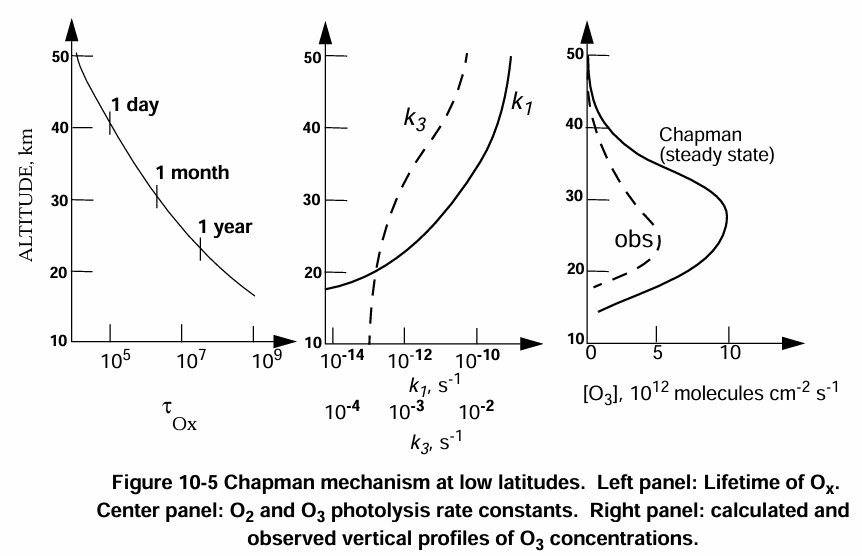
Source: Daniel J. Jacob, ‘Introduction to Atmospheric Chemistry’, online course materials at Harvard (CC BY 3.0). https://projects.iq.harvard.edu/files/acmg/files/intro_atmo_chem_bookchap10.pdf
By analysing the kinetics of these reactions – that is, the speed at which they occur – models suggest that ozone (O3) persists for roughly one day in the upper stratosphere, and up to a year at around 25 kilometres height. Stratospheric ozone peaks between 20 and 35 kilometres, but even at its maximum, levels remain low (around 8 ppm). For a detailed discussion, see:
https://projects.iq.harvard.edu/files/acmg/files/intro_atmo_chem_bookchap10.pdf
This delicate balance between solar UV-radiation and stratospheric O2 and O3 is called the Chapman cycle, after the scientist who first described it in 1931 (Chapman, S. (1931b), Bakerian Lecture—Some phenomena of the upper atmosphere, Proc. R. Soc., 132, 353–374).
Photolysis of oxygen and ozone does not directly produce heat, as UV energy is used to break molecules into free O atoms. So, where does the heat come from? In the Chapman cycle, the photolyzed free O atoms oxidize (“burn”) O2 to O3 and oxidize (“burn”) O3 to form 2 molecules of O2. These chemical reactions are exothermic, meaning they release heat, as in all burning processes. This released heat primarily warms the stratosphere.
Without O3, UV-C would quickly deplete O2 in the stratosphere, allowing harmful UV radiation to bleach Earth.
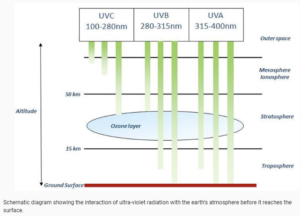
Source: National Environment Agency, Singapore. https://www.nea.gov.sg/corporate-functions/weather/ultraviolet-index/uv-radiation-uv-index
Together, stratospheric O2 and O3 block 100% of harmful UV-C radiation from reaching Earth’s surface, 90% of UV-B radiation, and about 50% of UV-A radiation. UV-C breaks up DNA, whilst UV-B and UV-A cause sunburns, skin cancer, and eye damage. Without stratospheric ozone, Earth’s surface would be sterilized by intense UV radiation. Stratospheric ozone is essential for the preservation of life on Earth.
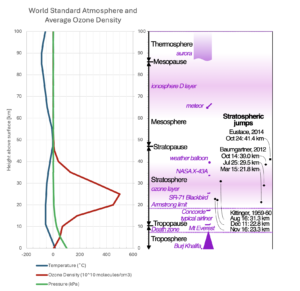
Source: Refreeze the Arctic Foundation; based on US Standard Atmosphere 1976 data (public domain) and ozone climatology.
The graph displays total atmospheric pressure (green, x-axis), with lower pressures indicating fewer air molecules, and height (both y-axes). Inside the graph, the atmosphere’s temperature profile (blue) shows how temperature decreases in the troposphere by the lapse rate of about 6.5°C /1km to reach on average -60°C at the top of the troposphere (x-axis). Rapid warming begins in the stratosphere at approximately 20 km height, which corresponds with an increase in ozone concentration (red, x-axis). The concentration of ozone reaches its peak between 20 and 30 km height. At the top of the stratosphere, the temperature is around 0°C and ozone levels drop nearly to zero. Yet, even at 30-40 km altitude, ozone-induced heating remains significant. Why is this?

Source: McPeters et al. (2005), ‘Ozone climatological profiles for satellite retrieval algorithms’, Geophysical Research Letters. Reused under AGU’s policy permitting figure reuse in academic works with full attribution.
This phenomenon is a result of the mole mixing ratio. As the pressure in the stratosphere decreases with altitude (due to a decreasing number of molecules), ozone becomes relatively more abundant. The ozone mole mixing ratio peaks between 30 and 40 km height. Where the mixing ratio is greater, absorption of a particular amount of UV radiation can have a greater effect on the overall air temperature at that height.
