
Ozone layer depletion
Key concepts: CFCs and HCFCs. Ozone hole. CO2-induced stratospheric cooling.
Satellite debris. Kessler syndrome.
However, as with the radiation balance, humans are now disrupting the fragile natural ozone balance, which has been stable for millions of years, with potentially disastrous consequences for the planet.
In the 1970s and 1980s, research revealed that industrial refrigerant gases, mainly chlorofluorocarbons  (CFCs) and hydrochlorofluorocarbons (HCFCs) were depleting the ozone layer. These halogenated compounds, containing carbon (C), hydrogen (H), fluorine (F), and chlorine (Cl), have low reactivity and long atmospheric lifespans, allowing them to diffuse into the stratosphere (see Chapter 3, GWP). There, solar UV-radiation splits off the highly reactive chlorine atom РCl Рfrom the molecule. Take for example freon-12, the production of which is now banned under the Montreal Protocol. In the stratosphere, freon-12 undergoes photolysis:
CF2Cl2 + hν→ CF2Cl + Cl
The breakaway Cl atom breaks down ozone, reducing its availability to block harmful UV radiation:
Step 1: Cl+ O3 → ClO + O2 Step 2: ClO + O → Cl + 2 O2
Overall reaction: O3 + O → 2 O2 (ozone sink)
Chlorine is able to destroy so much of the stratospheric ozone because it acts as a catalyst that is regenerated at the end of the process. After each set of reactions, chlorine begins the destructive cycle again with another ozone molecule. One chlorine atom can thereby destroy thousands of ozone molecules.
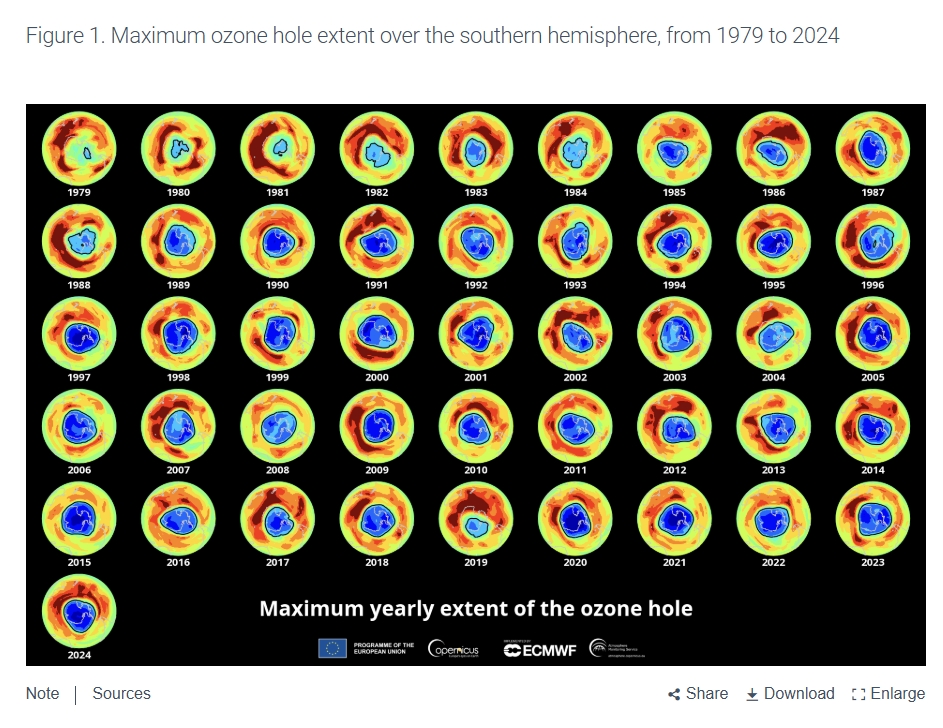
Source: European Environment Agency (EEA); data: Copernicus Atmosphere Monitoring Service (CAMS). https://www.eea.europa.eu/
Concerns over increased UV exposure due to ozone depletion, led to bans under the 1987 Montreal Protocol, most recently revised in 2018 (Quito). CFCs and HCFCs were replaced by hydrofluorocarbons (HFCs), which lack chlorine and have zero ozone depletion potential (ODP) but remain high global warming potential greenhouse gases (see Chapter 3, GWP).
Recent evidence suggests that, while the rate of ozone depletion has decreased, it persists, exhibiting a pronounced seasonal pattern with peak losses occurring during the Antarctic spring.
(South Pole Station ozone sondes: variability and trends in the springtime Antarctic ozone hole 1986–2021
Bryan J. Johnson, Patrick Cullis, John Booth, Irina Petropavlovskikh, Glen McConville, Birgit Hassler,Gary A. Morris, Chance Sterling, and Samuel Oltmans).
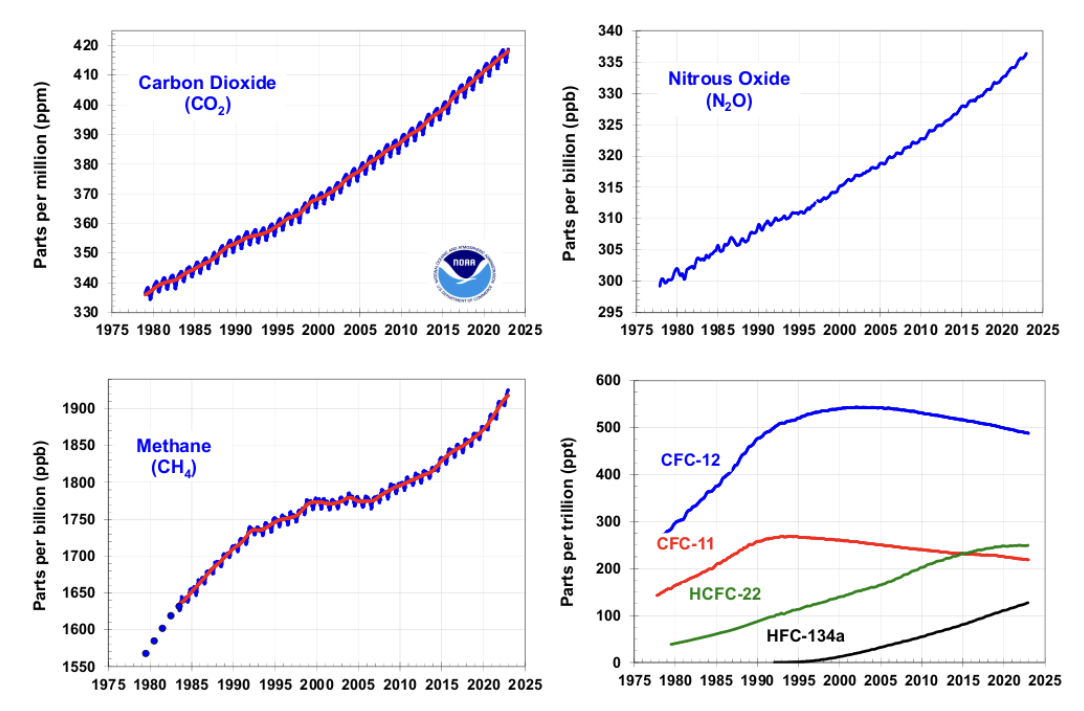
Source: NOAA Global Monitoring Laboratory. Public domain. https://gml.noaa.gov/aggi/ I
Multiple factors contribute, with lingering atmospheric concentrations of CFCs and HCFCs playing a role. Please note the difference of concentration on the y-axis of the above graphs, ranging from ppt to ppm. Also check out:
https://theconversation.com/countries-agreed-to-ban-ozone-depleting-chemicals-in-the-1980s-but-we-found-five-cfcs-increasing-to-record-levels-in-the-atmosphere-202925
Intriguing research (e.g., Ferreira et al., 2024, https://doi.org/10.1029/2024GL109280) points to aluminium oxide aerosols, produced during satellite re-entry burn up, as another possible culprit. These aerosols can persist in the stratosphere for decades. Interacting with residual CFCs and HCFCs, they may catalyse chlorine-activated ozone depletion. If confirmed, the rapid proliferation of internet-supporting mega-constellations of Low Earth Orbit (LEO, typically at a height of 550 km) satellites, including Starlink, Kuiper, and Guowang, may contribute to accelerated ozone depletion.
Decommissioned satellites typically burn up in the mesosphere, releasing aluminium oxide aerosols that accumulate in the stratosphere. By some estimates, by 2033, satellite debris will add approximately 3,500 MT of aerosols to the stratosphere, comparable to the amount from meteorite burn up. After that, it is projected to far exceed this amount. Check out the link, with a fascinating video of Starlink satellites viewed from the ISS:
https://theconversation.com/thousands-of-satellites-are-due-to-burn-up-in-the-atmosphere-every-year-damaging-the-ozone-layer-and-changing-the-climate-251845
The Starlink case. By November 2024, SpaceX had launched 6,700 Starlink satellites. When fully deployed, this LEO mega-constellation will include approximately 8,000 satellites. The lifetime of Starlink satellites is roughly 5 years as opposed to the usual 25 years for larger MEO satellites (Medium Earth Orbit: from 2.000 km to 35.786 km height) and GEO satellites (Geostationary: around 35.786 km height, always assuming that the atmosphere will stop expanding due to global warming!). Incidentally, the International Space Station (ISS) and Tiangong Space Station too are in LEO, orbiting around Earth in about 90 minutes. As these Starlink satellites reach the end of their operational life, thousands will deorbit annually, necessitating yearly relaunching of thousands of replacement satellites. The same applies for the recent first launches for the competing Kuiper and possibly Chinese Guowang mega-constellations.
This also raises concerns about stratospheric aerosol injection (SAI), which would require daily injections of thousands of metric tons of sulphate particles into the stratosphere, potentially further disrupting the fragile stratospheric ozone balance. Check out: https://theconversation.com/the-ozone-hole-above-antarctica-will-keep-opening-up-each-spring-for-decades-to-come-heres-why-that-still-matters-237013)
It is now understandable why O3 depletion causes stratospheric cooling because O3, a key reactant in the exothermic Chapman cycle, is going missing. The depletion also leads to increased UV radiation reaching Earth’s surface in areas where O3 has thinned significantly (ozone “hole” above Antarctica).
However, even after taking into account CFCs and HFCs still present in the stratosphere, significant additional stratospheric cooling is still occurring. What is going on?
CO2 levels in the warming troposphere are rising rapidly. Scientists now see it as a stock problem – there’s too much built up to remove easily – rather than a flow problem where cutting emissions would quickly lower concentrations. Even if we stopped emitting CO2 today, the excess would linger in the atmosphere for centuries. As CO2 accumulates in the troposphere, some of it gradually drifts into the thinner air of the stratosphere.
Just as in the troposphere, CO2 in the stratosphere is a greenhouse gas that absorbs infrared (IR) radiation. Its absorption bands span roughly 0.75–2.5 µm for incoming solar near-IR and 5–70 µm for outgoing terrestrial IR. Unlike in the denser troposphere, where absorbed IR energy is often redistributed through molecular collisions, CO2 in the rarified stratosphere mostly re-emits this energy as IR radiation in all directions due to the low collision frequency (check out Chapter 3, Greenhouse gases absorb infrared radiation, but they re-emit it; Kirchhoff’s law). Adding CO2 increases the stratosphere’s emissivity at IR wavelengths, driving more IR emission.
Because the stratosphere is much colder than the troposphere, the emitted IR radiation is weaker (blackbody flux ‚àù T4). Half of this weak IR radiation escapes directly to space, cooling the middle and upper stratosphere. The other half is directed downward, but it is too weak to significantly warm Earth’s surface.
This overall effect – CO2-induced stratospheric cooling – was first predicted in 1967 by Manabe and Wetherald and later confirmed through observations. Their pioneering work, which helped shape modern climate science, earned them the 2021 Nobel Prize in Physics. (Wetherald passed away in 2011).

Source: Benjamin Santer / UCLA newsroom. https://newsroom.ucla.edu/releases/stratospheric-cooling-vertical-fingerprinting
At present, stratospheric cooling is in the order of 1.8°C – 2°C, a magnitude higher than the natural variation of abt +/- 0.15°C. Stratospheric cooling is one of the most compelling pieces of evidence that climate change is primarily driven by anthropogenic CO2 emissions.
Variations in solar radiation, or other cosmic factors, cannot explain this phenomenon. To start with, the solar constant is remarkably stable. Furthermore, even if increased solar radiation were responsible for global warming, the fluxes of UV-C and UV-B ASR would increase, boosting photolysis in the Chapman cycle and heating the stratosphere. Our planet however is warming while the stratosphere is cooling, confirming that anthropogenic CO2 emissions are the primary cause of global warming.
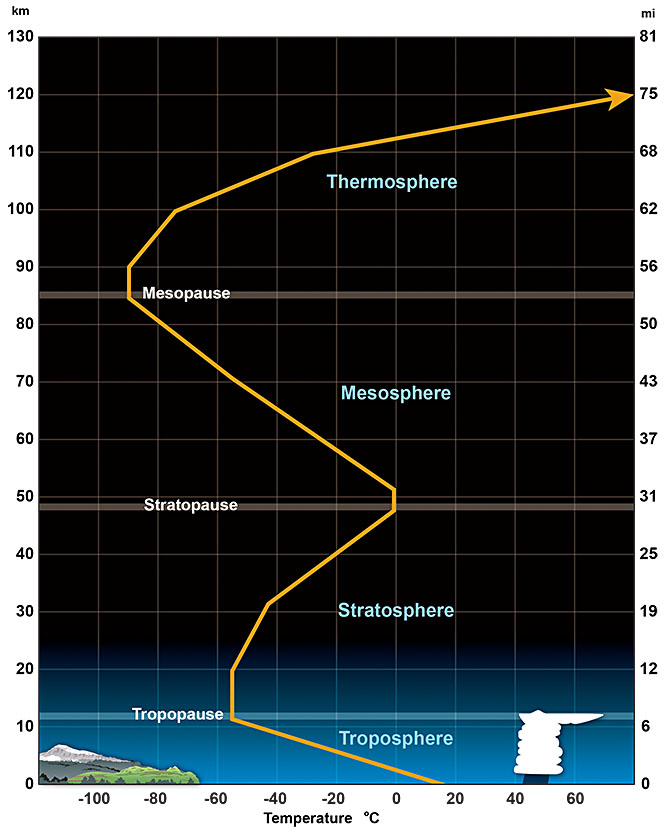
Source: NOAA – The Atmosphere. Public domain. https://www.noaa.gov/jetstream/atmosphere/layers-of-atmosphere
Ref. Average temperature profile for the lower layers of the atmosphere . Source: NOAA The Atmosphere; https://www.noaa.gov/jetstream/atmosphere/layers-of-atmosphere ]
Cooling in the upper atmosphere causes the thermosphere – the layer where most LEO satellites orbit (at roughly 200–600‚ÄØkm height) – to contract downward. This thins the air at typical satellite altitudes, reducing atmospheric drag, the natural brake that gradually slows satellites and pulls defunct spacecraft and debris into the lower thermosphere and mesosphere to burn up. With weaker drag, space junk can remain in orbit for decades or even centuries, accumulating in crowded orbits and raising the risk of collisions.
Satellite launches have surged, with more sent up in the past five years than in the previous 60 combined, forcing operators to carry out frequent collision-avoidance manoeuvres. A single collision in low-Earth orbit could generate massive debris and trigger a chain reaction of further collisions. Such “runaway instability” could render certain crowded orbits unsafe for functional satellites or future satellite deployment.
This phenomenon is known as the Kessler Syndrome, named after Donald J. Kessler, who first proposed it in 1978. In 2025, Donald Kessler and Hugh Lewis revisited the concept at the 9th European Conference on Space Debris. Sabine Hossenfelder provides an accessible overview of their findings in this informative YouTube video: https://www.youtube.com/watch?v=8ag6gSzsGbc&t=10s
Scientists are now questioning whether this proliferation of LEO-satellite constellations, like Starlink, is sustainable. They also warn that the long-term stability of Earth’s orbital environment may hinge on reducing… greenhouse gas emissions (and therefore reducing stratospheric cooling; check out: https://news.mit.edu/2025/study-climate-change-will-reduce-number-satellites-safely-orbit-space-0310).
Have we unleashed yet another tragedy of the commons – this time in near-Earth space? It is a technological challenge worthy of our era, matched only by our persistent inability to manage the mess we create.
Stratospheric cooling is dynamic: it will increase with rising anthropogenic CO2 emissions but may decrease if ozone depletion is reversed (scientists hope the latter will take place between 2045 and 2065).
Sabine Hossenfelder discusses stratospheric cooling and related subjects humorously in her YouTube video (for those who appreciate German humour). The material is complex but understandable for readers familiar with the concepts of radiation spectra and absorption curves discussed in Chapters 2 and 3:
For a fascinating account on how to measure stratospheric cooling, check out:
https://user.eumetsat.int/resources/case-studies/tropospheric-warming-and-stratospheric-cooling-in-the-21st-century
