
Probabilities. How to beat the odds.
Key concepts: 70% probability of a 2-4°C rise in temperature above pre-industrial levels by 2100. Definition of 1.5°C below pre-industrial levels. Large-scale deployment of MCB would beat the odds.
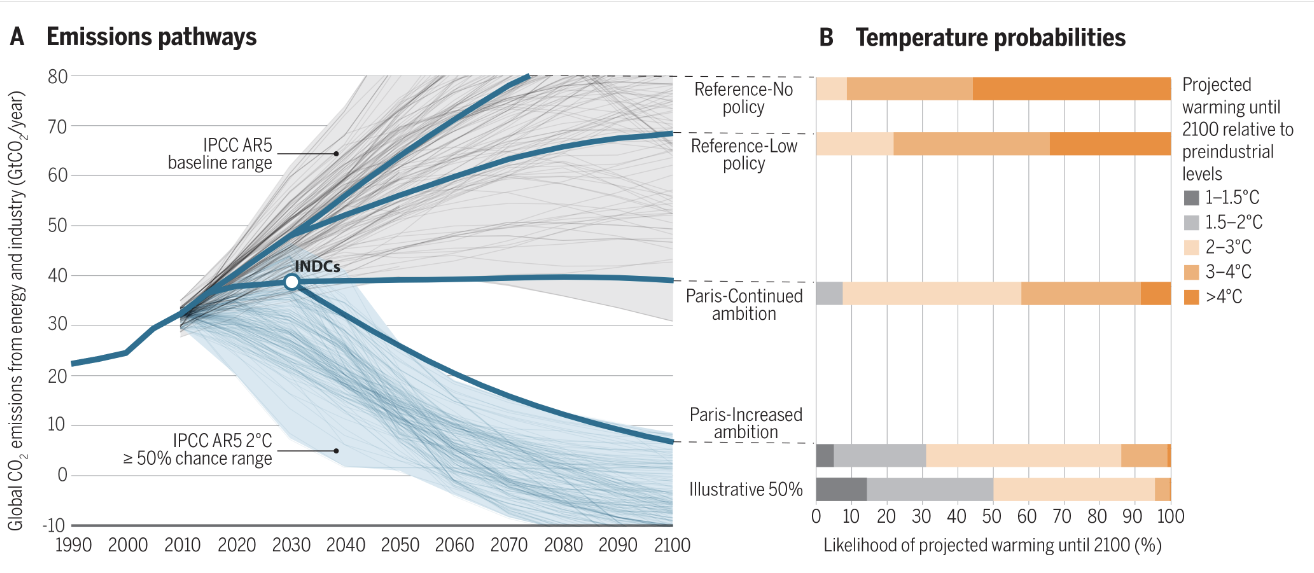
Source: Wikimedia Commons; adapted figure provided by Jae Edmonds. Original: Fawcett, Iyer, Clarke, Edmonds, Hultman, McJeon, Rogelj, Schuler, Alsalam et al., ‘Can Paris pledges avert severe climate change?’, Science 350(6265) 1168-1169 (2015). Licensed under CC BY-SA.
Even climate models developed 25 years ago could have predicted today’s — and even tomorrow’s — global warming with considerable accuracy, provided they had been supplied with reliable projections of future anthropogenic GHG emissions. Instead, emissions continued to rise, reaching new record highs almost every year over the past quarter century. Preliminary estimates for 2025 indicate emissions exceeding a grim 60 Gt CO2e, compared with an average of 53.6 ± 5.2 Gt CO2e/yr during 2014–2023 and roughly 30 Gt CO2e/yr in the 1970s, alongside declining aerosol cooling (see Chapter 1, How It All Began). Currently, the likelihood of limiting warming to 1.5°C above pre-industrial levels by 2100 is about 5%… in the most optimistic scenario. This is about the same likelihood as warming (above) >4°C in moderate scenarios. Most GHG emission scenarios predict with 70% probability a 2-4°C rise in temperature above pre-industrial levels by 2100. Such increase in temperature would be a climate catastrophe.
Our society must be ready to combat by all means possible future temperature rises. Every 0.1°C counts! Yes, we can. As individuals by the lifestyle-decisions we make, as voters by the politicians we chose to be custodians of our planet and the future of our children.
Check out how tiny lifestyle changes can have a huge impact on global warming: https://refreezethearcticfoundation.com/get-involved/
What does 1.5°C below pre-industrial levels actually mean? Unbelievably yet true, this was defined at COP21 (Paris) as “a more than 50% chance to stay below 1.5°C”. Would you get in an airplane if it had “a more than 50% chance of landing safely”? Of course not, and yet this is the way our politicians are steering the planet towards climate catastrophe.
However, the RAF is sponsoring the development of Marine Cloud Brightening (MCB), a mild form of cloud engineering which could temporarily cool the planet by mitigating the sharp temperature rises already “baked” into our climate (check out Chapter 1, TCRE). Over 50 years, MCB could help guide us back to a safer temperature range, allowing us time to significantly reduce greenhouse gas emissions and scale up CO2 removal (the Climate Repair Deal discussed in the Introduction). Critically, MCB could prevent us from crossing tipping points, beyond which global warming spirals out of control. Such large-scale deployment of MCB would beat the odds!
