
Soot
Key concepts: Black carbon 101. Cryconites. Transarctic shipping route. Zombie fires.
Soot, or black carbon, results from incomplete combustion of carbon-containing materials like fossil fuels and wood. Major industrial sources of soot include the tire industry, steel and metals manufacturing, oil refining and coal-fired power plants (especially Chinese and Indian ones, see Chapter 13, Proposition 6, An environmental catastrophe called coal). Transportation reliant on internal combustion engines, including most road vehicles as well as marine and air transport, is also a major source of soot emissions.
“Natural” sources of black carbon include the massive forest fires which now regularly rage in the Mediterranean, the USA, Canada and in the boreal forests during summer. Similarly, forest fires deliberately set to clear land in the Amazon rainforest and the tropical forests of the Indonesian archipelago also contribute to black carbon emissions. However, industrial processes, coal-fired power plants and transportation remain the prevalent emitters for now (as quantified in Chapter 13, Proposition 6, Historic cumulative CO2 emissions).
Black carbon, a fine particulate matter, can deeply penetrate the lungs, leading to respiratory issues and contributing to around 4 million premature deaths annually, including child deaths from lower respiratory infections like pneumonia.
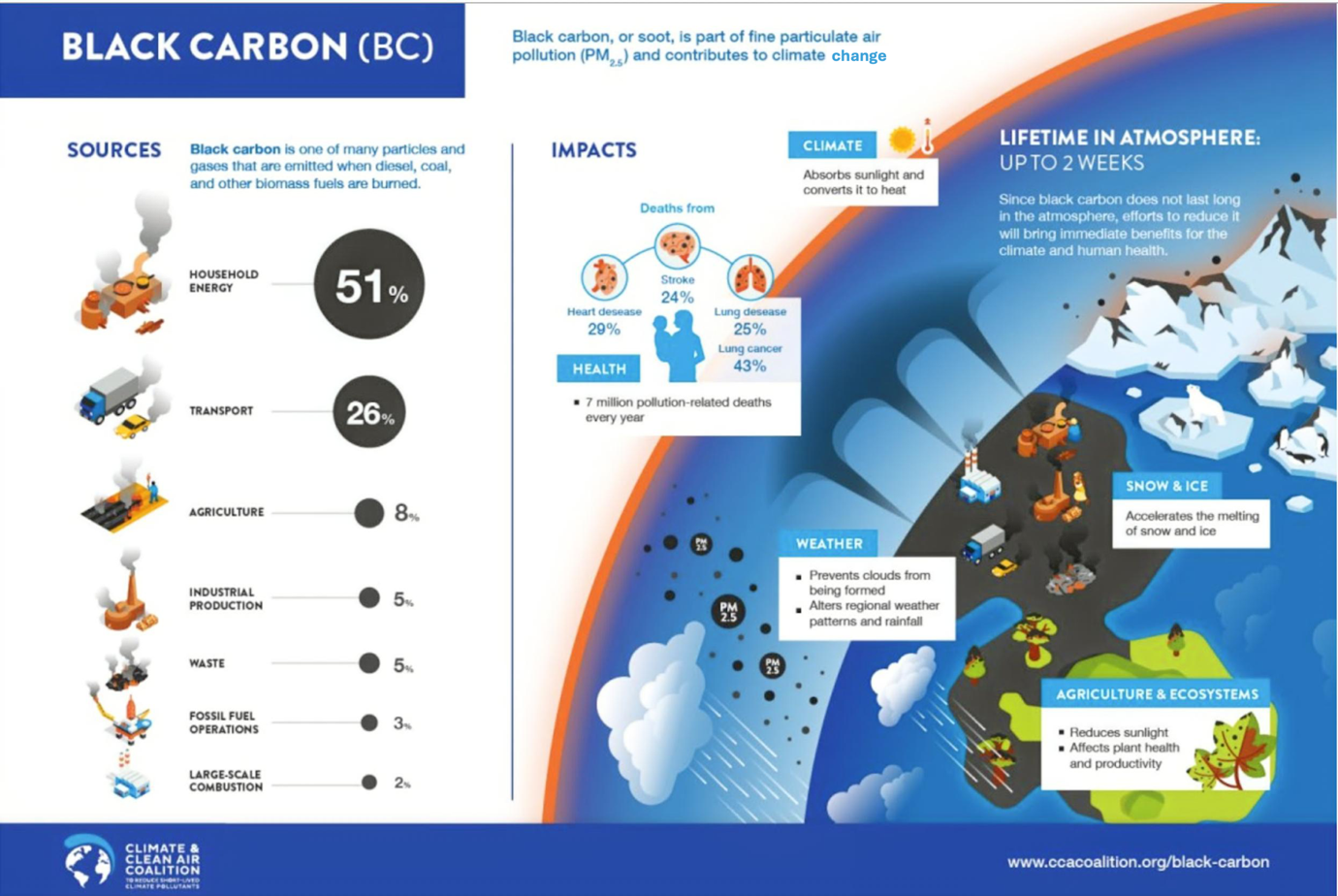
Source: UN Climate and Clean Air Coalition (CCAC). https://www.ccacoalition.org/black-carbon
Sources and impact of soot
Black carbon has both cooling and warming effects. Overall, the dominant effect of black carbon emissions is to warm the planet, through their role in reducing albedo and absorbing heat. Scientists estimate that black carbon’s 20-year GWP is about 4,470(!) and its 100-year GWP 1,055-2,240 (see Chapter 3, Greenhouse gases’ Global Warming Potential). Black carbon is a significant contributor to global warming, particularly in the Arctic.
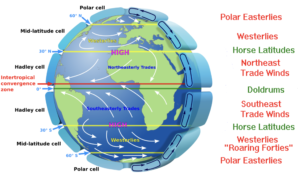
Global circulation of Earth’s atmosphere displaying Hadley cell, Ferrell cell and polar cell. Source: Adapted by RAF from ‘NASA depiction of earth global atmospheric circulation’ by Kaidor (Wikimedia Commons, CC BY-SA 3.0).
Black carbon can be transported over thousands of kms by atmospheric currents, particularly the westerlies in the Northern hemisphere, from a latitude of 30 N (the Horse latitudes) in north-easterly direction. When black carbon settles on ice and snow, it reduces their reflectivity (albedo), causing them to absorb more heat and melt faster, which exposes rock and sea water that absorb even more heat from the sun. In some places, these particles – called cryoconites – mix with ice algae after they settle on the snow. The algae are photosynthetic microorganisms that turn dark to protect themselves from the harsh sunlight on the ice. As the algae bloom and combine with the cryoconites, they become embedded in the snow.
Check out where the horse latitudes get their name from
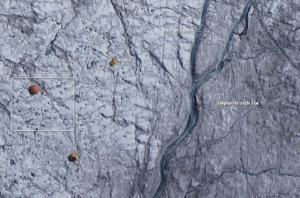
Source: NASA Dark Snow Project. https://science.nasa.gov/earth/earth-observatory/dark-snow-project-84607/
In Greenland, between 2000 and 2015, the average ice albedo of Greenland’s ice declined by 5 percent. This small shift has already caused dark snow to melt at a rate that’s 300 percent higher than regular, clean ice.
Black carbon not only contributes to the warming and melting of the Greenland and Arctic ice caps, but also of glaciers in Nepal and on the Tibetan plateau, further impacting global climate patterns. Dark (or black) snow is now even found in Antarctica, due to increased research activity and… tourist cruises(!) in the region.
The International Maritime Organisation has admitted that the role of soot emitted by shipping contributes an astonishing 20% of the shipping industry’s total climate global warming potential (due to GHGs + soot emissions). To date, marine soot emissions are unregulated.
The EU’s arctic shipping black carbon footprint for instance, represents an astonishing 16.5% of total(!) shipping soot emissions. And yet, soot (carbon black) emissions are not included in the GHG intensity standard for EU marine fuels.
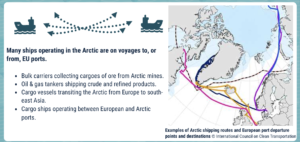
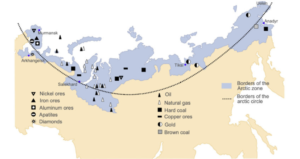
Bullet list + map: ‘Examples of Arctic shipping routes and European port destinations’ showing main route categories (bulk carriers, oil/gas tankers, cargo Arctic-to-southeast-Asia, cargo intra-European).
Source: Chanysheva, A.; Kopp, P.; Romasheva, N.; Nikulina, A. (2021). Migration Attractiveness as a Factor in the Development of the Russian Arctic Mineral Resource Potential. Resources 10(6), 65. CC BY 4.0. https://doi.org/10.3390/resources10060065

Source: Arctic Portal — The Arctic Gateway. Free for educational/outreach use with attribution. https://arcticportal.org/
Russia’s exploitation of Arctic resources will worsen black carbon emissions as shipping increases exponentially along the Northern Sea route to Europe, Japan, and China. By mid-century, global warming may even allow regular cargo ships to travel directly via the Trans Arctic route. Marine fuel black carbon emissions must be addressed with utmost urgency to prevent the collapse of Greenland’s albedo.
Mitigation could be quick and easy: switching all ships from heavy fuel oil to cleaner distillate fuels and diesel could reduce emissions by about 44%, and installing diesel particulate filters could cut emissions further, to over 90%, with a modest (<10%) increase in fuel cost (see also Chapter 13, Proposition 10, Transition is easier done than said). Even better, but longer term, marine engines powered by ammonia (NH3) would not release any greenhouse gases or soot at all.
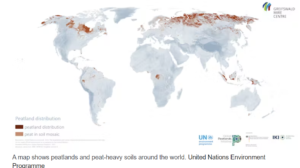
One reason so much carbon is being released into the atmosphere by boreal wildfires is because many of the fires are burning through peatlands.
Source: UN Environment Programme, Greifswald Mire Centre, and Global Peatlands Initiative.
Peat is made of decomposed organic matter and it is a large natural carbon source. Due to ever higher summer temperatures, frozen peatlands are drying up and becoming highly flammable. Simple lightning strikes have caused massive peat fires, which tend to burn longer than regular forest fires. Peat fires have been shown to smoulder under a snow blanket in winter as “zombie fires” to then reignite in summer.
