
Why is the Arctic heating up 3-4 times faster than the average?
Key concepts: Positive feedback loops. Arctic amplification. Has Greenland’s ice sheet crossed a tipping point? Antarctica’s Doomsday glacier.
Compared with the 1951-1980 baseline, the Northern Hemisphere is heating much faster, particularly the European continent. The news is even worse for the Arctic region, where temperatures exceed 6.4°C above the baseline. This “Arctic amplification” is mainly due to the rapid decline of the Arctic sea ice cap.
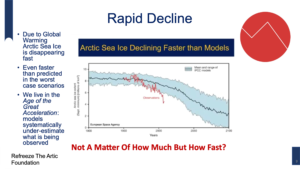
Source: Refreeze the Arctic Foundation. Underlying data: European Space Agency / IPCC models.
Worse, the decline goes much faster than even the most pessimistic IPCC models predict. This acceleration is due to the presence of positive feedback loops in climate change. These loops amplify warming processes, causing them to accelerate.
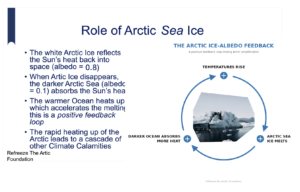
Source: Refreeze the Arctic Foundation. Original RAF composite illustration.
One example is the Arctic sea ice melt. There, a well-documented positive feedback loop is accelerating temperature increases in the Arctic until all the ice is gone. Additionally, the absence of convection in the Arctic ocean and the increase of water vapour and clouds, lead to additional arctic surface warming. Once the ice is gone, the Arctic ocean will heat up further, potentially triggering other tipping points such as the disintegration of the Greenland Ice Cap and the collapse of the AMOC (see Chapter 9. Tipping Points). Crossing any of these tipping points would trigger a global climate catastrophe.
What happens in the Arctic does not stay in the Arctic.
According to the RAF, we live in the Age of the Great Acceleration (of Global Warming).
Racing against time, the RAF is fast-tracking research into Marine Cloud Brightening (MCB). The RAF believes MCB is our best chance to slow Arctic warming, break its dangerous feedback loops, and restore sea ice. If the Arctic refreezes, its runaway warming – the Arctic Amplification – would grind to halt, at least for now. The RAF’s message is simple: More Ice, More Life.
Learn more about MCB – and why the RAF sees it as the most promising tool in the climate toolbox to help cool the planet – on the RAF website: https://refreezethearcticfoundation.com/
The RAF supports marine cloud brightening because sea water is rich in salt, the basic ingredient for MCB cloud nucleation nuclei (CCNs), and marine clouds contain fewer aerosols than heavily aerosol-contaminated land clouds. Adding sea salt CCNs to marine clouds, with less aerosol competition for available water, enhances the brightening effect of MCB most. Additionally, the dark sea absorbs more heat than land, making brightening over the ocean more impactful.
Scientists are continually discovering new positive feedback loops in climate change, which may explain their ongoing underestimation of its impact. Unfortunately, despite having discovered thousands of positive feedback loops, they have not yet discovered major negative feedback loops that would mitigate global warming or cool the planet.
Positive feedback loops like the arctic ones are quickly melting mountain glaciers, threatening communities from China to Peru and across the Indian subcontinent. In 2024, Venezuela became the first country to lose ALL its glaciers with the disappearance of the 5,000-meter-high Humboldt (La Corona) glacier in the Sierra Nevada de Mérida. Switzerland lost 65-75% of its glacial mass since 1850.
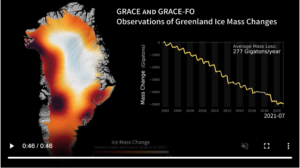
Source: NASA/JPL-Caltech. Public domain.
If all of Greenland’s 2,850,000 cubic kilometres of land ice melted, it would raise global sea levels by 7.2 meters. However, since land ice melts due to rising atmospheric temperatures, not seawater, it could take centuries for all the ice to melt. Currently, 277 gigatons(!) of Greenland ice melt into the Arctic Ocean as freshwater annually, equivalent to an ice block covering central Amsterdam and as high as Mount Everest. Unfortunately, numerous positive feedback loops are accelerating the melt, potentially making the ice cap unstable, with abrupt changes for the worse. Many scientists believe Greenland has crossed a tipping point, where the melting becomes irreversible and rapid. A significant sign of this was on August 14, 2021, when the first-ever rainfall was recorded at Greenland’s highest station, Summit Station, at 3,216 meters above sea level.
Also, check out the role of soot in the Arctic amplification (Chapter 7, Soot).
What happens in the Arctic does not stay in the Arctic.
In fact, Planet Earth has two ‘refrigerators’ that also act as ‘mirrors’: the Arctic, including the Greenland ice mass, and Antarctica, a vast continent covered by a land-based ice mass.
Antarctica is now also showing signs of extreme non-linearity.
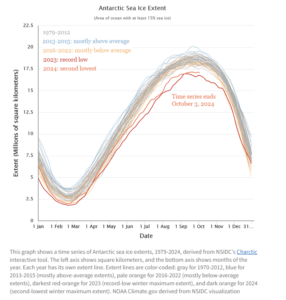
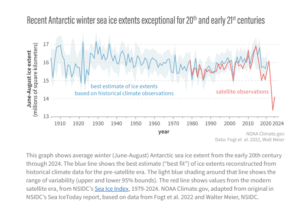
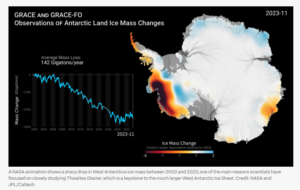
As the above three graphs show, all is not well with Antarctica (the 2023 Winter Sea Ice Loss event was a statically highly significant “5-sigma” event).
Take the Thwaites Glacier, for example.
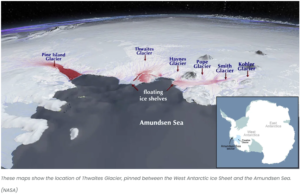
Dubbed the ‘Doomsday Glacier,’ West Antarctica’s large Thwaites Glacier is showing alarming signs of collapse. A recent 6-year research program using Icefin, a robotic under-ice oceanographer, revealed that warm seawater tidal action beneath the glacier will accelerate its melting this century (2024). Thwaites, about the size of Florida, is critical because its loss would raise sea levels by 65 cm. Even more concerning, it also anchors the entire West Antarctica ice sheet. If this ice sheet collapses, sea levels could rise by a catastrophic 3.3 meters. The loss of Thwaites is a key tipping point in the climate crisis (see Chapter 9, Tipping Points).
Learn more about Icefin on: https://schmidt.astro.cornell.edu/icefin/
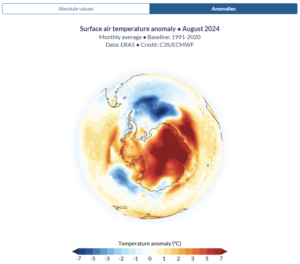
Source: Copernicus Climate Change Service (C3S/ECMWF). Data: ERA5, reference period 1991-2020.
At the time of writing (August 2024), an unprecedented heatwave has struck Antarctica during its winter, with temperatures reaching 28°C above baseline on some days: https://pulse.climate.copernicus.eu/?utm_source=press&utm_medium=referral&utm_id=cb-feb-2024
This is the second such heatwave in rapid succession, following the March 2022 heatwave, which saw temperatures spike 32°C above baseline. In Antarctica, that kind of warming in the winter generally continues into summer months and can lead to a collapse of Antarctic ice sheets.
Seawater level projections are continually being revised upward. For example, the KNMI (Dutch meteorological institute) now predicts a 1.20-meter rise by 2100 under a +2°C scenario, up from the previous consensus of 0.7 meters (Hansen J. et al. now predict +2°C by 2045, see Chapter 1, Climate Sensitivity). Official projections do not currently anticipate the catastrophic collapse of the Greenland ice cap or the Thwaites Glacier, likely because these scenarios are too alarming to present to the public. However, these events are unfolding, as detected by the twin GRACE-FO satellites, which monitor Earth’s water movement.
What happens in the Arctic – and the Antarctic – has calamitous repercussions for our planet.

Make a donation
invest in the planet's future
RAF’s mission is to prove that MCB can brigthen marine clouds enough to cool the planet and thereby refreeze the Arctic. We have no time to waste. Donate today.